
1. The Macroeconomic Imperative: A Market at an Inflection Point
North America’s food service industry stands on a cliff. According to the National Restaurant Association, labor is now the single most significant operating expense in the restaurant business, with a median of 36.5% of sales in the full-service segment. This is not just a cost issue; it is a structural crisis. California’s fast-food workers’ minimum wage will hit $20 per hour in 2024, while average hourly wages in Los Angeles have hit $21.08, 160% of the cost of an average burger meal.
At the same time, the demand side of this equation is transforming radically. The North American online food delivery market was valued at $38.0 billion in 2024 and is forecast to grow to $105.8 billion by 2033 at a CAGR of 11.57%. Other estimates place the 2025 market size at $37.91 billion, heading toward $54.98 billion in 2030. Fundamental consumer behavior shifts toward convenience, smartphone penetration, and expansion in delivery logistics networks underpin this.
These two data points indicate that labor costs are rising inexorably, while volumes in off-premises dining are accelerating. The restaurant industry already operates on razor-thin margins; limited-service restaurants report a median pre-tax profit of just 4.0% of sales. The industry cannot resist such pressure in any other traditional way. Price increases are also impossible because wage growth in Philadelphia, for example, has outstripped the federal minimum wage by 164%.
This is not a temporary fluctuation. This is a permanent reordering of the labor economy. The question is no longer whether restaurants will automate but when and how.
2. The Critical Bottleneck: Why Packaging Is the Final Frontier
Almost all restaurant operations have now been automated: POS systems are digitized, kitchen equipment is increasingly innovative, and delivery logistics are optimized by algorithms. One critical operation remains stubbornly manual: packaging.
The packaging landscape is evolving toward convenience-oriented formats, such as folding cartons, microwaveable trays, and recyclable, portion-controlled flexible pouches. Consolidating hot soup containers, cold salads, sauce packets, and fragile utensils into a single flexible plastic bag is an operation that defies traditional automation.
Why? Packaging is the convergence point of every complexity the food industry can throw at it. Non-standard containers, variable weights, liquids, temperature differentials, and the need for spatial reasoning all collide at the packing station. Technically, this is a flexible manipulation problem at the highest level of difficulty in robotics.
The options currently available in the market are low-margin cup sealers that only solve a small part of the problem or integrated system lines costing $200,000–$300,000 per store—economically prohibitive to the average restaurant. That is a huge opportunity.
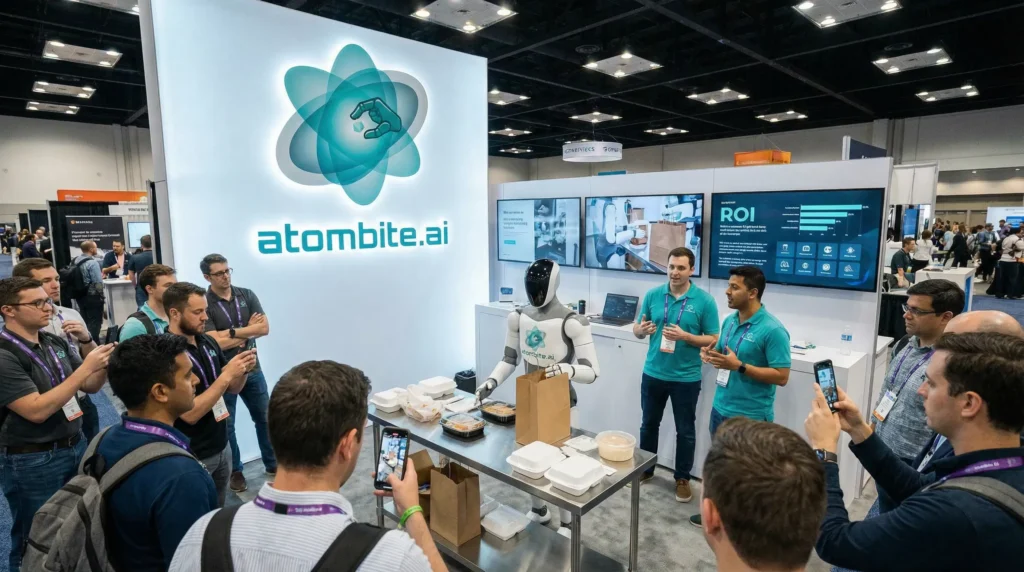
3. AtomBite.AI ‘s Thesis: The Brain Over the Body
The industry-wide mistake has been a hardware focus. Humanoid robots, dexterous hands, and walking abilities dominate the narrative. This fundamentally misunderstands the problem.
Hardware is not the bottleneck. Legs are mostly solved (Unitree, Boston Dynamics). Hands will be commercially viable within 3-5 years. The real bottleneck is the brain: understanding a physical context, determining the appropriate force and sequence, and reliable execution in the wild.
AtomBite.AI is based on a core strategic insight: We are at the “2016-2017” stage of embodied intelligence. The foundational transformer architecture has been set; scaling laws are being discovered. What is lacking is the data flywheel—real-world deployment, data collection, and model refinement in a virtuous loop—where the field will find its “ChatGPT moment.”
By focusing on flexible manipulation—grasping, sorting, packing, and placing—AtomBite is creating a data flywheel in the highest value and difficulty domain. Each ghost kitchen deployment and each package handled in a returns warehouse yields proprietary data unobtainable by simulation or public datasets. This thus creates a moat that deepens with every deployment.
This pragmatic thinking is reflected in our technical approach. Instead of the computationally prohibitive dream of a single universal model for all scenarios, we have a hybrid architecture: large language models deal with long-tail exceptions, while lightweight specialized models deal with 90% of repetitive core operations. A successful strategy that DYNA-1 follows in autonomous driving—learning continuously from operational data enables autonomous exploration and error recovery without prohibitive inference costs.
4. The Economic Case: Compelling ROI
Consider a typical North American restaurant that processes 100 daily delivery orders at a $30 average ticket:
Current costs:
- Packaging labor: ~$3,000 per month
- Order disputes and refunds (assumed at 3% of delivery revenue): $2,700 per month
- Total hidden cost: $5,700 per month
AtomBite Robotics as a Service (RaaS) Solution:
- Base subscription: $2,000–$2,500 per month
- Share of dispute recovery: $200–$400 per month
- Total monthly cost: $2,200–$2,900
Net client benefit: $1,100–$2,825 per month
The economics are more straightforward when viewed through direct labor substitution. The fully loaded cost of a restaurant employee in North America is between $3,500 and $3,900 per month. At roughly $2,000 a month for the AtomBite solution, this yields monthly savings of $1,500–$1,900 or a 45% reduction in labor expense.
Hardware costs, currently $8,000 to $14,000 per unit, are declining by about 25% annually. This translates to payback times for restaurant operators of 5 to 11 months and 36-month contract gross margins of 70–83%. As hardware costs decline and labor costs rise, this ROI will only accelerate.
5. Scalability: From Ghost Kitchens to Global Infrastructure
The initial beachhead market is restaurant packaging, but this is only the first use case of a fundamentally reusable capability. The same “hand, brain, and control architecture” that can place a soup container in a flexible plastic bag can be adapted with minimal effort for tasks elsewhere in the physical economy:
- Ghost kitchens: Already leveraging our core packaging capabilities
- Micro-fulfillment centers: Handling fragile fresh produce that has not been amenable to traditional automation
- E-commerce returns facilities: Handling non-standard soft packages-the fastest-growing waste stream in logistics
- Last-mile delivery hubs: Interface between merchants and gig-economy drivers
This is not a pivot; this is a “capability trajectory.” If the “universal hand” can manage the chaos of a restaurant packaging station, it must, by definition, be able to do simpler tasks elsewhere. Every new vertical is a revenue opportunity and a source of data that will strengthen the core.
6. Execution: The Team and the Strategy
A vision without execution is a hallucination. AtomBite is an extraordinary mix of technical depth and commercial experience.
Technical leadership, including a former CTO of Meituan’s food delivery business who managed petabyte-scale operations, understands the architecture of AI and what it takes operationally to serve food in massive volumes. The data infrastructure, built by Meituan’s former technical leadership on data and recommendation systems, will ensure that every deployment improves the models. Leading research in robotic diffusion transformers further complements this.
Commercialization follows a similarly pragmatic approach: enter through software. The initial “Capability 0” product is a pure-software validation tool that connects to POS, visually verifies orders, and reduces disputes for a monthly fee of $200-300. It is both a revenue source and a low-friction point for data capture and customer relationships.
With several regional chain LOIs and the validation tool going into pilots, the pathway to market is clear and capital-efficient.
7. Conclusion: A Window of Opportunity
Embodied intelligence winners will be defined over the next three to five years. Those who chase the dream of general-purpose humanoids without real-world data will be left behind when the “ChatGPT moment” arrives. Those already flying data wheels in production environments-collecting the high-quality, task-specific data that even the best foundation models will need to be fine-tuned.
Packaging labor costs represent a $13.3 billion total addressable market in North America across approximately 800,000 food service locations that offer delivery. A 5% share of that is a $665 million addressable market. This does not include adjacent verticals processing returns, fresh grocery fulfillment, and last-mile logistics that are worth multiples of this.
The timing could not be better: rising labor costs, off-premise dining expanding at double-digit rates, falling hardware costs, and a maturing AI stack. AtomBite.AI is uniquely positioned on the most complex problem (flexible manipulation), with a clear market path, a world-class team, and a strategy that accrues value with every deployment.
The physical economy awaits its universal hand. The question is not if, but who.
Appendix: Data Sources
| Metric | Value | Source |
|---|---|---|
| Labor as % of full-service sales | 36.5% | National Restaurant Association, 2025 |
| CA fast food minimum wage | $20/hour | Harri Wage & Labor Cost Index, 2025 |
| LA average hourly wage | $21.08 | Harri Wage & Labor Cost Index, 2025 |
| NA online food delivery market (2024) | $38.0 billion | Research and Markets, 2026 |
| NA online food delivery market (2033) | $105.8 billion | Research and Markets, 2026 |
| NA market CAGR (2025-2033) | 11.57% | Research and Markets, 2026 |
| NA market estimate (2025) | $37.91 billion | Mordor Intelligence, 2025 |
| Limited-service pre-tax margin | 4.0% | National Restaurant Association, 2025 |